A commercial building’s overhead envelope is undeniably its most critical defense mechanism against the relentless assault of the elements. It stands as a massive, continuous shield, protecting millions of dollars in highly sensitive inventory, heavy operational equipment, complex electrical infrastructure, and, most importantly, human capital. Yet, despite its paramount importance to the survival of the business, the top of the building is frequently the most neglected asset in a property manager’s portfolio. Because it is out of sight, it is often out of mind—until a major, undeniable failure suddenly forces it into the spotlight.
The harsh reality of facility management is that ignoring the early warning signs of overhead degradation and treating systemic structural failures as minor nuisances inevitably leads to disastrous financial and operational consequences. Water is an incredibly patient and destructive force. Waiting for a saturated ceiling to completely collapse onto a retail floor, or allowing hidden moisture to cultivate toxic mold that overruns the building’s central HVAC system, turns what should be a planned, manageable capital improvement into a full-blown operational crisis. It introduces devastating business interruptions and severe legal liabilities that can cripple a company’s quarterly performance.
This comprehensive guide is designed to shift your perspective from reactive panic to proactive asset management. We will walk property owners, facility directors, and real estate investors through the critical, diagnostic steps needed to thoroughly evaluate their overhead infrastructure. From identifying hidden moisture tracks and recognizing structural sagging to calculating the exact financial tipping point where endless patching becomes a mathematical loss, this roadmap will provide the clarity and confidence needed to make a proactive, highly strategic upgrade decision.
Tracking Interior Water Intrusion and Moisture Damage
The most dangerous threats to a commercial structure rarely announce themselves with a sudden, dramatic cascade of water. Instead, overhead failures usually begin as slow, insidious leaks that travel along structural beams, electrical conduits, and HVAC ductwork long before they ever breach the interior airspace. By the time you see a brown stain forming on a ceiling tile in an office suite, the water has already caused significant, hidden damage to the layers above. Tracking this moisture early is your first line of defense.
Conduct an Above-Ceiling Flashlight Inspection Monthly
Proactive property management requires looking past the cosmetic finishes of your building. You cannot simply wait for a puddle to form on a tenant’s desk to initiate an investigation. You must establish a routine protocol to inspect the hidden interstitial spaces of your facility.
-
Establish a localized inspection grid: Once a month, designate your maintenance personnel to safely climb a ladder and lift several acoustic drop-ceiling tiles across different, heavily trafficked zones of the building. Focus particularly on areas directly beneath massive rooftop HVAC units, skylights, and internal roof drains.
-
Look for the path of least resistance: Using a high-lumen tactical flashlight, inspect the corrugated steel decking and the underside of the structural joists. Water rarely drops straight down from a leak; it runs along the steel flutes until it finds a joint or a penetration point.
-
Identify active corrosion and saturation: Look closely for active drips, spreading patches of orange rust on the steel, or heavily water-stained fiberglass batt insulation. Noticing these hidden signs early prevents the need for emergency roof repairs that disrupt daily tenant operations, allowing you to schedule targeted investigations before a massive indoor flood occurs.
Document the Frequency of Patching and Active Leaks
Memory is a highly unreliable tool when managing a large-scale commercial property over several years. If you do not have a hard data trail of every maintenance intervention, it is incredibly easy to underestimate just how much time, labor, and capital is being wasted on a failing system.
-
Maintain a centralized incident log: Keep a strict, centralized digital log of every single time your maintenance team has to deploy catch-buckets, lay down water-absorbent barriers, or call for external service. Track the exact geographic coordinates of the leak, the severity of the water intrusion, and the dates of the occurrences.
-
Identify the point of diminishing returns: Pay close attention to the shifting frequency of these incidents. When the timeline shifts from a rare, isolated annual occurrence caused by a severe storm to a predictable, monthly headache every time it drizzles, simple patching is no longer a viable financial strategy.
-
Analyze your vendor expenses: Consistently paying exorbitant emergency dispatch fees to multiple roof repair companies to fix the exact same failing seams or recurring punctures is a primary indicator that the system has reached the absolute end of its operational lifespan. At this point, the membrane is likely too brittle to hold a patch, and you are simply throwing good operating capital into a dying asset.
Assessing Membrane Blistering, Bubbling, and Surface Degradation
For properties utilizing single-ply membranes (like TPO, PVC, or EPDM) or traditional built-up asphalt systems, the actual exterior surface provides a wealth of diagnostic information if you know how to interpret the visual and tactile cues. The membrane is subjected to relentless ultraviolet radiation, extreme thermal expansion, and heavy weather impacts. Over time, the chemical composition of these materials breaks down, signaling that a total failure is imminent.
Step Carefully and Feel for Spongy Insulation
When conducting an exterior walk-through, your eyes are not your only diagnostic tool. The physical sensation beneath your work boots as you walk the perimeter can instantly reveal the hidden health of the underlying structural deck and the insulation layers.
-
Understand the role of rigid insulation: Beneath the thin, waterproof membrane lies a thick layer of rigid insulation boards (typically polyisocyanurate or high-density wood fiber). These boards provide the necessary R-value for energy efficiency and give the membrane a solid substrate to rest on.
-
Identify moisture saturation: As you walk slowly across the surface, pay incredibly close attention to how the deck yields. If the surface feels unusually soft, squishy, or spongy—resembling the feeling of walking on a thick gym mat—water has inevitably breached the membrane and completely saturated those underlying insulation boards.
-
Recognize the severity of the symptom: This saturated insulation is a catastrophic failure common in older flat roofing systems, meaning the underlying deck is actively rotting, the structural fasteners are corroding, and the building’s thermal efficiency has been entirely compromised. Wet insulation will never dry out on its own; it must be physically removed and replaced.
Map Out Areas of “Alligatoring” and Deep Cracks
The sun is the ultimate enemy of commercial building materials. Over decades of exposure, the intense UV rays bake the essential oils, plasticizers, and flexible compounds right out of the membrane. This process turns a once-pliable, rubberized surface into a rigid, fragile shell.
-
Look for the reptile scale pattern: Carefully inspect the surface for areas where the membrane has become deeply sun-baked and brittle, creating a distinct, intersecting pattern of deep cracks that heavily resembles the scales of a reptile. In the commercial maintenance industry, this is universally referred to as “alligatoring.”
-
Evaluate the loss of elasticity: Once a built-up or modified bitumen surface loses its elasticity and cracks this deeply, its waterproofing integrity is permanently destroyed. It can no longer expand and contract with the daily heating and cooling of the building, meaning those cracks will only widen and deepen over time, eventually splitting entirely open to the elements.
-
Collaborate with specialists: Taking detailed, high-resolution photographs of these compromised, brittle areas and sharing them with trusted roofing professionals will help accurately diagnose the severity of the degradation. They can determine whether the cracking is superficial enough to warrant a restorative liquid-applied silicone coating, or if the degradation has reached the substrate, making a full, multi-layered tear-off absolutely mandatory.
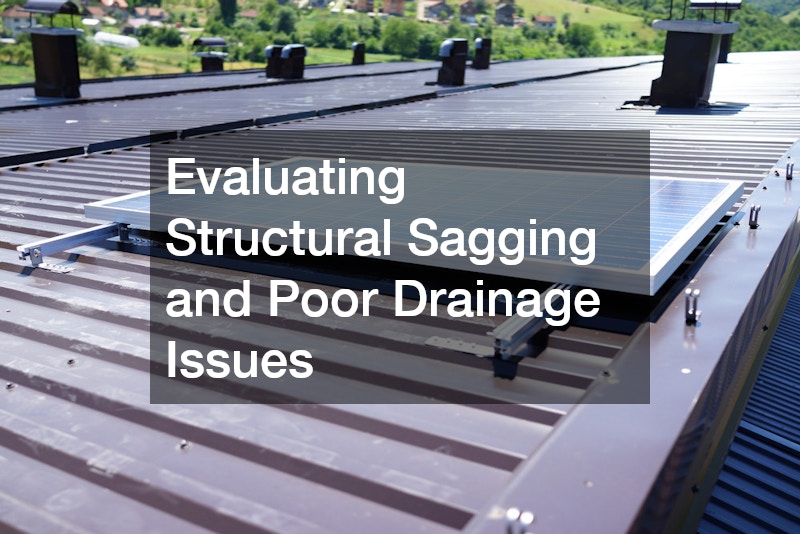
Evaluating Structural Sagging and Poor Drainage Issues
A commercial building is designed to handle immense structural loads, but water weight is a uniquely deceptive and dangerous force. A single inch of water spread across a 10,000-square-foot surface weighs over 5,000 pounds. When the systems designed to shed that water begin to fail, the resulting weight can warp steel joists, crush insulation, and threaten the overarching architectural framework of the entire facility.
Monitor Ponding Water 48 Hours After a Rainstorm
Commercial surfaces are rarely perfectly level; they are engineered with a subtle, calculated pitch using tapered insulation boards to direct water toward internal drains or exterior scuppers. When this pitch is compromised, water becomes trapped, creating a severe and compounding structural hazard.
-
Enforce the 48-hour inspection rule: Make it a strict, non-negotiable operational protocol to inspect the exterior surface exactly two days (48 hours) after a significant heavy rainstorm.
-
Identify crushed tapered systems: If deep, expansive pools of standing water are still present after two days of dry weather, the system has failed. This usually indicates that your tapered insulation has been slowly crushed under the weight of previous pooling or heavy foot traffic, completely altering the necessary slope required to push water toward the designated evacuation points.
-
Understand the compounding danger: Ignoring standing water essentially turns your commercial building into a suspended swimming pool. The longer water sits, the faster the membrane degrades under the magnified UV rays. Ultimately, this negligence leaves you vulnerable, forcing you to rely on expensive 24 hour roofers when the immense, localized weight eventually causes a catastrophic interior breach directly over your occupied tenant spaces.
Inspect Parapet Walls and Scuppers for Structural Stress
The perimeter edges of the building, where the horizontal surface meets the vertical parapet walls, endure incredible amounts of wind uplift and structural shifting. Furthermore, the scuppers (the openings in the wall that allow water to drain into the downspouts) are prime locations for severe membrane stress and separation.
-
Look for bowing and separation: Walk the extreme perimeter edges of the building and look closely for any bowing along the parapet walls. Inspect the flashing where the horizontal membrane transitions up the vertical wall. If the flashing is peeling away, cracking, or separating where the edge metal meets the drainage scuppers, you have a massive vulnerability.
-
Identify the signs of water pressure: These separations actively signal that immense water weight and trapped freeze-thaw ice are pushing aggressively against the structure, physically tearing the sealed seams apart.
-
Review original architectural blueprints: Comparing the current, sluggish drainage flow and the physical state of the scuppers to the original architectural blueprints of previous local roof installations can reveal just how much the building has settled over the decades, or how badly the structural pitch has degraded since the building was first commissioned. If the water cannot escape, the system must be entirely re-engineered.
Identifying Fastener Back-Outs and Rust in Hard Substrates
For industrial properties, massive warehouses, and agricultural facilities utilizing hard corrugated panels or standing seam architectural systems, the diagnostic signs of failure look vastly different than those of a single-ply membrane. Metal systems are incredibly durable, but they face highly unique environmental stresses, primarily driven by extreme temperature fluctuations and the relentless oxidation process.
Check for Gaping Seams and Backed-Out Screws
A massive metal structure operates almost like a living, breathing entity. As the morning sun hits the vast expanse of steel or aluminum, the metal rapidly heats up and expands. As the sun sets, the metal cools and aggressively contracts. This daily cycle of extreme movement places immense stress on the fasteners holding the massive panels to the structural purlins below.
-
Understand thermal shock: Walk the horizontal and vertical seam lines methodically. Look closely at the neoprene-washered screws that secure the panels. Over the years, the violent expansion and contraction of “thermal shock” can cause these screws to literally reverse themselves out of the decking.
-
Identify water entry points: A backed-out screw leaves a gaping, unsealed hole directly into the building’s interior. Furthermore, the constant shifting can elongate the screw holes in the metal panels themselves, making it impossible to simply drive a new, tighter screw into the same location.
-
Seek specialized assessments: When you notice widespread fastener failure or rippling along the seams, bringing in a specialized metal roofing contractor to assess the damage is critical. They possess the engineering expertise to determine whether re-fastening with oversized screws and applying a thick elastomeric coating is a viable restorative option, or if the panels have stretched and warped too far to ever be safely salvaged.
Measure the Spread of Surface Rust and Panel Deflection
Rust is the undeniable arch-nemesis of steel components. While minor, localized surface rust on an older agricultural building might be a purely cosmetic issue, widespread oxidation on a commercial facility is a structural death sentence that must be addressed immediately before high winds tear the panels off the building.
-
Differentiate between surface and structural rust: Do not simply assume that rust can be painted over with a rust-inhibiting primer. You must physically test the integrity of the oxidized areas. Probe deeply rusted zones—particularly along the lower eaves where water naturally sits, or around HVAC curbs—with a heavy screwdriver or an awl.
-
Test for structural deflection: If the metal easily flakes away, breaks off in thick, crumbling chunks, or gives way entirely under light physical pressure, the structural integrity of the panel is completely gone. The steel has oxidized entirely through, meaning it can no longer support snow loads or resist severe wind uplift.
-
Accept the reality of the degradation: Widespread structural rust, panel deflection, and decaying seams are the definitive indicators that localized patching is a completely useless endeavor. At this severe stage of decay, budgeting for full roof replacements is the absolute only safe, legally compliant, and structurally sound path forward for the property ownership group.
Calculating the Financial Tipping Point of Ongoing Maintenance
At a certain point, the decision to upgrade your facility’s overhead infrastructure shifts from a purely structural debate into a rigid, mathematical calculation. Property managers often fall into the trap of believing that spending a few thousand dollars every quarter on emergency patches is more financially responsible than absorbing the massive capital expenditure of a brand new system. However, when you analyze the true, hidden costs of an aging, failing envelope, the math tells a vastly different story.
Audit Your Heating and Cooling Energy Bills
The thermal efficiency of your building is directly tied to the condition of your insulation. As we discussed earlier, when a membrane fails and water saturates the rigid insulation boards beneath, those boards completely lose their thermal resistance (R-value). Wet insulation transfers heat incredibly fast.
-
Compare year-over-year utility data: Pull your facility’s HVAC utility costs from the past three to five years and run a meticulous year-over-year comparison.
-
Identify unexplained energy spikes: A sudden, massive, and otherwise unexplained spike in cooling costs during the peak summer months, or skyrocketing heating costs in the winter, usually means the overhead thermal barrier has been entirely destroyed by saturated, wet insulation. Your HVAC units are now working in constant overdrive, bleeding your operational budget dry.
-
Calculate the thermal ROI: The energy savings gained by utilizing modern roof replacement services to install highly reflective, white TPO membranes and thick, high R-value polyiso insulation are staggering. In many commercial facilities, the drastic reduction in monthly utility bills pays for a surprisingly large portion of the capital upgrade project over the first decade of its lifespan.
Run a Cost-Benefit Analysis on Patching vs. Tearing Off
Every dollar spent on an emergency patch that will inevitably fail again in six months is a dollar permanently lost. You must calculate the true, holistic cost of maintaining a dying asset to find your financial tipping point.
-
Calculate the holistic maintenance burden: Sit down with your accounting department and calculate the total amount of money your facility has spent over the last 24 to 36 months on emergency patching invoices. Add to that the costs of interior water damage cleanup, replacing stained ceiling tiles, ruined tenant inventory, and the unquantifiable cost of lost tenant productivity during those leak events.
-
Identify the mathematical threshold: The industry standard rule of thumb is clear: if this total reactive maintenance number exceeds five to ten percent of the estimated total cost of a brand new, fully warranted system, you are mathematically wasting money. You have crossed the tipping point where replacement is vastly cheaper than continuous repair.
-
Establish an accurate baseline: To make this final determination, gathering three highly competitive, detailed bids from established local roofers to establish an accurate baseline for your capital expenditure budget is essential. Having firm numbers in hand allows you to present a flawless financial argument to your executive board, allowing you to finally stop bleeding operational funds on a dying asset and invest in the future of the property.
Conclusion
The overhead envelope of a massive commercial building is not a silent, mysterious entity; it communicates its structural health incredibly clearly if you know exactly what signs to look for and how to interpret them. From the tell-tale spongy sensation of saturated insulation and the dangerous backing-out of metal fasteners to the undeniable, skyrocketing spikes in your monthly utility bills, the indicators of systemic failure are highly measurable and mathematically undeniable.
“A proactive approach to facility management transforms an impending disaster into a strategic, value-adding capital improvement.”
It is absolutely crucial to reframe how you view this massive undertaking. A new installation is not merely a frustrating, unavoidable sunk cost; it is a profound capital investment in the operational continuity of your business. Upgrading to a modern, highly engineered system drastically lowers your exorbitant monthly energy bills, drastically improves tenant comfort and retention, deeply protects your millions of dollars in interior assets, and massively increases the overall appraisal value and marketability of the property.
Do not wait for a catastrophic interior flood to force your hand, and do not allow the slow bleed of endless emergency patching to drain your operational reserves. Encourage your facility management team to take the initiative this week. Safely conduct a thorough visual audit of the exterior membrane, review your recent maintenance logs and utility bills for alarming trends, and schedule formal, comprehensive diagnostic inspections with highly vetted professionals. By taking decisive, proactive action today, you firmly protect your investment and secure the operational future of your commercial enterprise.