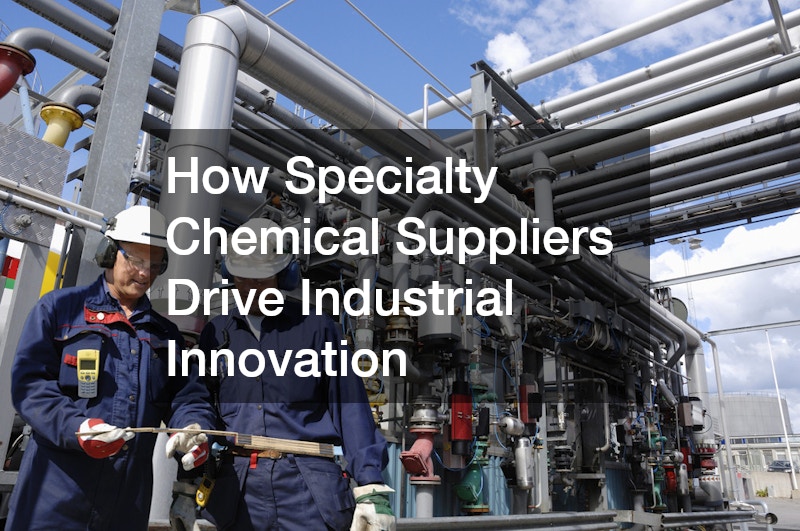
Industrial innovation depends on more than new machines, software, and production methods. Many advances also rely on specialized materials and chemical compounds that help manufacturers create products with specific characteristics. From electronics and automotive components to coatings, adhesives, and advanced materials, chemical solutions can play an important role in developing and improving industrial products.
As businesses pursue greater efficiency, durability, performance, and sustainability, they may need chemical materials designed for very specific applications. Specialty chemical suppliers can support these efforts by providing materials, technical information, and solutions tailored to particular industrial requirements.
Their role can extend beyond simply providing chemicals, as they may also contribute to product development, process improvements, and technological advancement.
Supporting Advanced Manufacturing
Modern manufacturing often requires materials with carefully controlled properties. Standard chemicals may not provide the performance needed for specialized applications, particularly when products must withstand demanding temperatures, pressures, chemicals, or mechanical conditions.
Specialty chemical products can be developed for specific purposes, helping manufacturers address these requirements. Materials may be formulated to improve adhesion, resistance, conductivity, flexibility, durability, or other characteristics.
By providing access to materials suited to particular applications, chemical companies can help manufacturers explore new production methods and product designs. This can make it easier for businesses to develop products that meet increasingly specific performance requirements.
Improving Manufacturing Efficiency
Industrial innovation is not limited to creating new products. Businesses also look for ways to make existing manufacturing processes faster, more consistent, and more efficient.
Chemical solutions can contribute to these improvements. Certain materials may help reduce processing times, improve product consistency, minimize waste, or simplify production steps.
Manufacturers can evaluate how chemical inputs affect their processes and determine whether alternative materials could improve performance. In some cases, even a small adjustment to a production process can create meaningful operational improvements when repeated across large production volumes.
Working with knowledgeable suppliers can help businesses understand how different materials may perform within their specific manufacturing environments.
Supporting Electronics and Technology
The electronics industry relies on a wide range of specialized materials. Components must often meet precise requirements related to conductivity, insulation, heat resistance, durability, and manufacturing tolerances.
Chemical materials can be involved in processes such as semiconductor manufacturing, circuit board production, cleaning, coating, and component assembly. As electronic devices become smaller and more sophisticated, manufacturers may require increasingly specialized materials.
Specialty chemical suppliers can help support these developments by providing materials designed for demanding technical applications. Their products may contribute to the manufacturing processes behind technologies used in consumer electronics, communications equipment, industrial systems, and other applications.
As technology continues to evolve, the materials used to manufacture technological products must evolve alongside it.
Advancing Automotive Manufacturing
The automotive industry is another area where specialized chemical materials can contribute to innovation. Modern vehicles incorporate a variety of materials designed to improve performance, safety, efficiency, and durability.
Chemical products may be used in coatings, adhesives, sealants, plastics, composites, lubricants, and other components. Manufacturers may seek materials that help reduce vehicle weight, improve corrosion resistance, increase durability, or support more efficient production.
The development of electric vehicles has also introduced new material requirements. Batteries, electrical components, thermal management systems, and lightweight structures can require materials with specialized properties.
As automotive manufacturers explore new technologies and production methods, chemical innovation can help provide some of the materials needed to make those developments possible.
Supporting Research and Development
Research and development plays a major role in industrial innovation. Businesses often spend significant time testing materials and production methods before bringing a new product to market.
Chemical materials can be an important part of this testing process. Researchers may need small quantities of specialized compounds for laboratory testing, prototypes, performance evaluations, or pilot production.
Specialty chemical suppliers can support these activities by providing access to materials with specific characteristics and supplying information about their properties. Consistent material availability can also help researchers compare results across multiple testing stages.
As successful concepts move from research into commercial production, reliable chemical sourcing becomes increasingly important.
Building Collaborative Partnerships
Innovation is often the result of collaboration rather than a single company’s efforts. Manufacturers, engineers, researchers, material scientists, and chemical companies can each contribute different knowledge to a development project.
A supplier that understands a customer’s application may be able to suggest materials or approaches that would not otherwise be considered. Open communication can help both sides understand technical requirements and identify practical solutions.
Long-term relationships can also make it easier to respond to changing production needs. When suppliers understand a manufacturer’s processes and goals, discussions about new materials and potential improvements can become more productive.
Industrial innovation relies on continuous improvements in materials, products, and manufacturing processes. Chemical solutions can provide manufacturers with properties that help them create more durable products, improve production efficiency, support emerging technologies, and respond to evolving industry requirements.
Specialty chemical suppliers can contribute to this progress by providing specialized materials alongside technical knowledge and application support. Their involvement can help manufacturers explore new possibilities and address complex material challenges.
As industries continue to develop, the demand for innovative chemical solutions is likely to remain an important part of technological progress. Collaboration between manufacturers and chemical companies can help transform specialized materials into practical solutions that support the next generation of industrial products and processes.